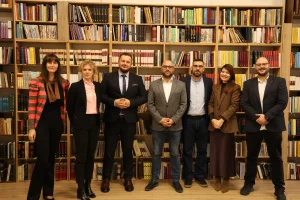
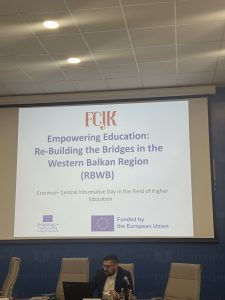
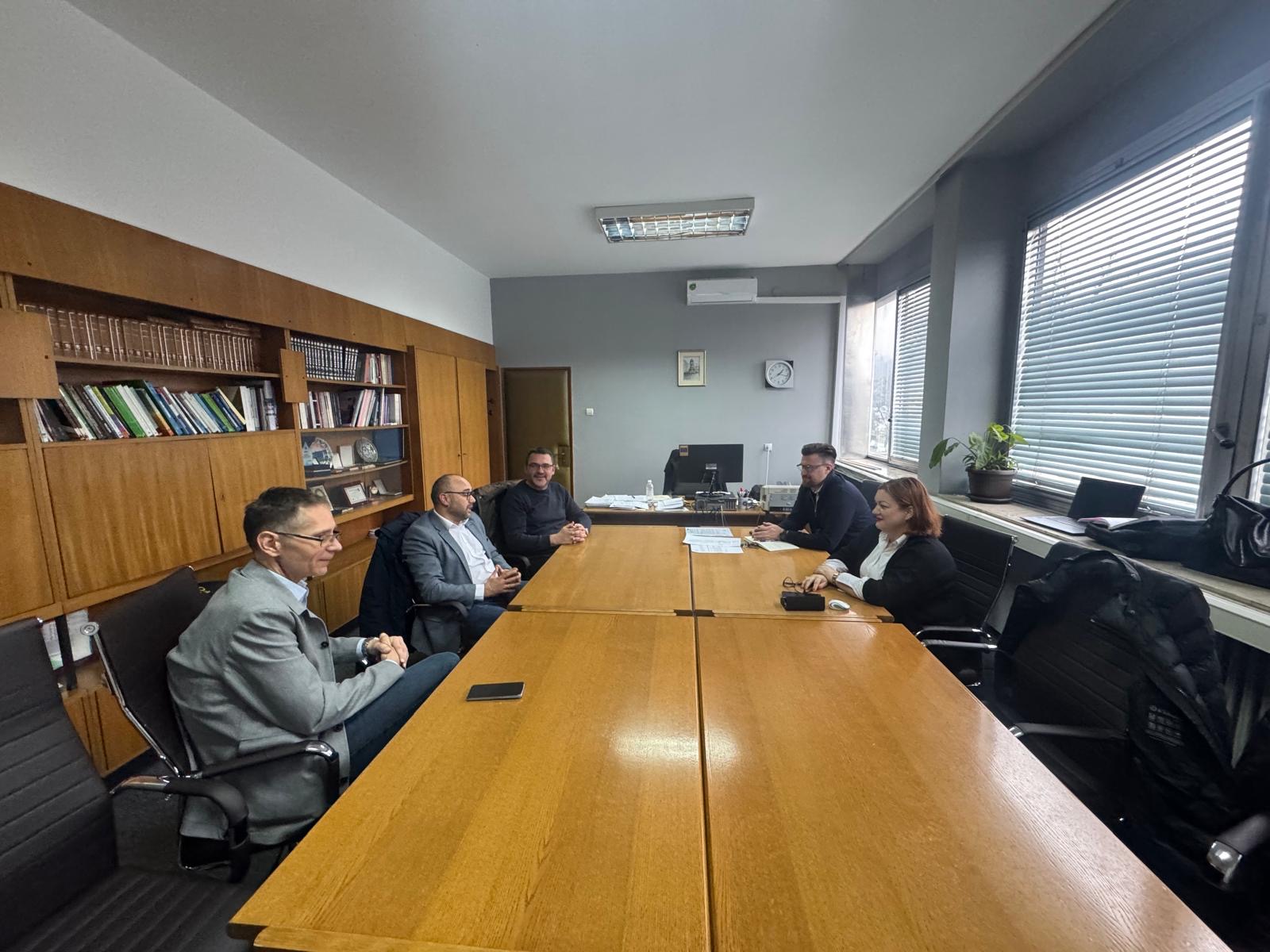
As part of the implementation of the Empowering Education: Re-Building the Bridges in the Western Balkan Region (RBWB), a coordination meeting between representatives of the Faculty of Montenegrin Language and Literature (FCJK) and the University of Tuzla was held in Tuzla.
Representing FCJK were Dean Prof. Dr Aleksandar Radoman and Vice-Dean for Education Prof. Dr Adnan Čirgić. The meeting was hosted by representatives of the University of Tuzla, including Vice-Rector Prof. Dr Jasmin Suljagić, Dean of the Faculty of Philosophy Prof. Dr Sead Nazibegović, Vice-Deans Prof. Dr Selma Kešetović and Prof. Dr Elvis Vardo, and Prof. Dr Amira Turbić-Hadžagić.
Vice-Rector Suljagić expressed satisfaction that the University of Tuzla is participating as a partner in the RBWB project, highlighting the importance of strengthening cooperation between higher education institutions and encouraging joint academic initiatives. Dean Nazibegović emphasised the readiness of the Faculty of Philosophy in Tuzla to contribute its institutional capacities to the successful implementation of the project and underlined the importance of joint activities in both research cooperation and mobility programmes for academic staff and students.
Dean Radoman referred to the long-standing and successful cooperation between the Faculty of Montenegrin Language and Literature and scholars from the University of Tuzla, noting that the RBWB project represents an important step forward in strengthening this collaboration at the regional level. He also emphasised the significance of the project as part of the Erasmus+ Capacity Building in Higher Education programme supported by the European Commission.
During the meeting, participants discussed the implementation plan of the project, with particular attention given to the joint activities planned for the three-year duration of the project. Discussions also addressed practical aspects of project implementation, including the formation of project teams, coordination mechanisms, and implementation timelines, while highlighting the importance of effective communication between the coordinating institution and partner universities.
Participants emphasised that the RBWB project represents a multidimensional initiative, encompassing the strengthening of administrative capacities, the procurement of equipment, external quality evaluation processes, the organisation of an international scientific conference, and the development and accreditation of a new study programme.
In light of the project’s scope and complexity, it was concluded that the timely formation of working teams and the clear distribution of responsibilities are essential for the successful and timely implementation of all planned activities.